More customers now type full questions into AI tools, such as "Who does same-day AC repair near Tampa?" or "What’s a good family accountant in Plano?" Instead of ten blue links, they often get a short written answer that names a few businesses. If you’ve wondered how those businesses got mentioned, and why yours wasn’t, you’re asking the right question.
Where AI Answers Get Their Information
Tools like Google’s AI Overviews, ChatGPT search, Perplexity, and Microsoft Copilot generally build answers from content they can find and retrieve on the web. That can include business websites, map listings, reviews, news coverage, and online business directories.
No company outside these platforms knows exactly how each one weighs its sources, and the methods change often. What is reasonably clear is that these systems work best with information that is easy to read, consistent across sources, and specific about who a business serves and what it does.
Make Your Business Easy to Describe
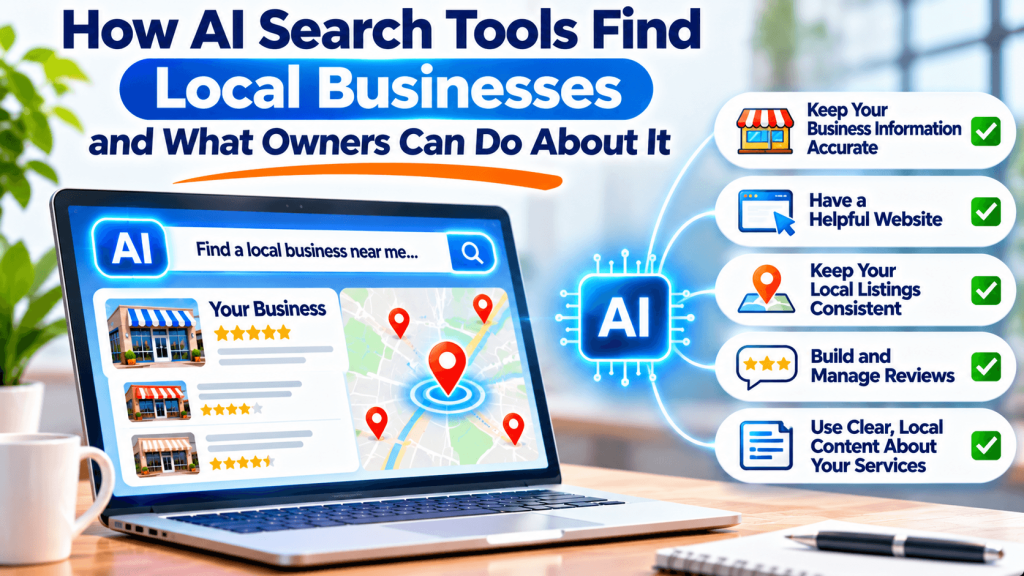
An AI tool can only repeat what it can find. If your website says "we handle all your needs" without naming services or cities, there’s little for any system to work with. Plain statements help: "We repair and install central air systems for homes in Hillsborough and Pasco counties."
The same goes for your listings. A complete business profile with an accurate category, service list, hours, and a clear description gives both people and software the facts they need. Answering common customer questions directly on your website, in a short FAQ, also helps because AI answers are often built around question-and-answer content.
Practical Steps for AI Search Visibility
Keep your name, address, phone number, and services identical across your website, Google Business Profile, Bing Places, and the directories you use. Contradictions make it harder for any system to state your details with confidence.
Earn genuine mentions in places that make sense for your industry, such as local news, trade associations, and relevant directory categories. Marketing agencies, for example, can list themselves under SEO, SMO and PPC services on Local Dir, where the category itself helps describe what they do.
Avoid stuffing pages with keywords or publishing thin location pages for cities you don’t serve. Accuracy and clarity tend to hold up better than shortcuts, and no tactic can guarantee your business will appear in an AI-generated answer.
Conclusion
AI search hasn’t replaced the basics of local marketing. It has made them more visible. Clear, consistent, and specific business information is the best foundation you can control. Review how your company is described on your website and on directories like Local Dir, and tighten anything vague or outdated.
Frequently Asked Questions
Can I pay to have my business recommended in AI answers?
Some platforms are testing ads near or inside AI results, but organic mentions in AI-generated answers can’t be bought directly. They depend on what the system finds and judges relevant. Your best approach is keeping accurate, detailed information across your website and trusted listings, and treating any paid placement as clearly separate advertising.
Why does an AI tool show the wrong hours for my business?
AI tools may pull from an outdated source, such as an old directory listing or a cached page. Update your hours on your website, Google Business Profile, and other listings first. Many AI tools also offer a feedback option to report inaccurate answers, which is worth using when you spot an error.
Is answer engine optimization different from regular SEO?
They overlap heavily. Answer engine optimization focuses on making content easy for AI systems to quote and summarize, such as direct answers to common questions and clearly structured pages. The foundation is the same as good SEO: helpful content, accurate business information, and a site that search tools can crawl easily.
Does schema markup help AI tools understand my business?
Structured data, such as LocalBusiness schema, gives search engines a standardized way to read details like your name, address, and hours. It can support understanding, but it isn’t a guarantee of visibility. Make sure any markup matches what’s visible on the page, since conflicting information undermines the purpose.